
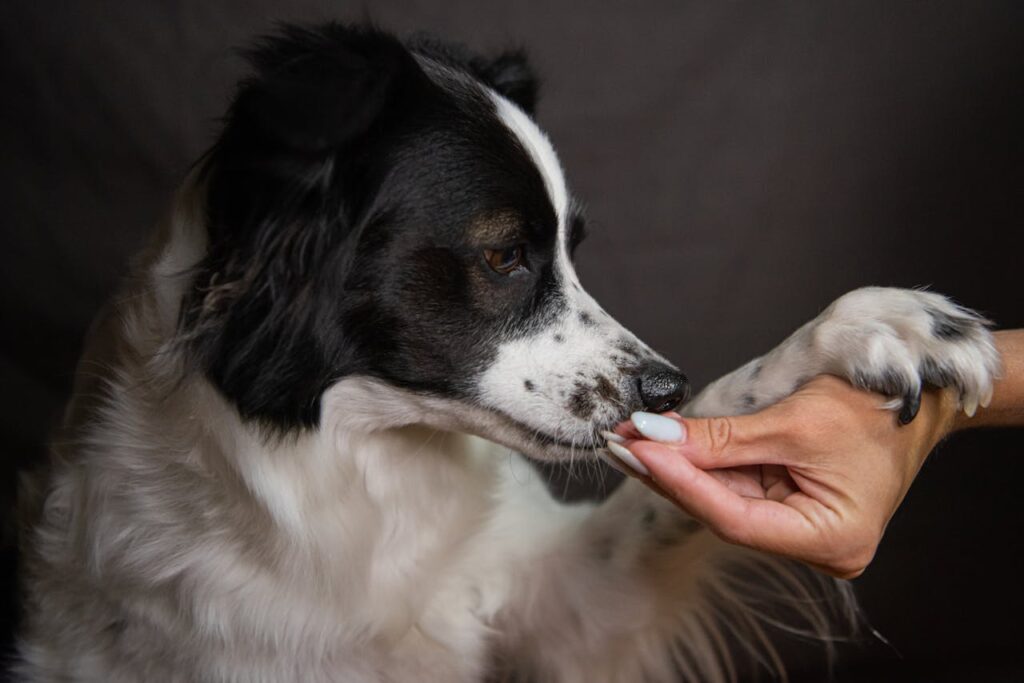
You might ask yourself why I write about a dog training method rather than focusing only on dog rehabilitation.
Good question. The simple answer is that these two things go hand in hand.
At High Five Paws, my approach to rehabilitation is very exercise-focused. But in order to communicate clearly what I want the dog to do—and to avoid frustration for both the handler and the dog—clear communication is key. Rewarding the dog at the right moment when they perform an exercise correctly makes a big difference.
In dog rehabilitation, motivation is just as important as the exercises themselves, and encouraging the right movement can greatly support recovery.
One powerful training tool I use with my own dogs at home, and often apply during rehabilitation, is conditioned reinforcement.
What Is a Conditioned Reinforcer?
A conditioned reinforcer is a signal that tells your dog they did the right thing and that a reward is coming. Over time, the signal itself becomes meaningful and motivating.
Common signals include a clicker or a verbal marker such as “Yes!” or “Good!”. In theory it can be anything you like, but I usually recommend avoiding hand signals. These require the dog to constantly watch you, which can take their focus away from the exercise itself.
These markers are repeatedly paired with something the dog already finds rewarding, such as food, praise, or play. Eventually, the marker itself becomes rewarding because the dog associates it with something positive.
Why Timing Matters
In rehabilitation sessions, timing is extremely important. Dogs may only perform the correct movement for a brief moment — perhaps a perfectly balanced sit-to-stand, a correct paw placement, or a controlled step.
A conditioned reinforcer allows us to:
- Mark the exact moment the correct movement occurs
- Communicate clearly with the dog
- Motivate participation, even when exercises are challenging
- Build confidence in dogs recovering from injury or neurological conditions
Because the signal happens instantly, the dog understands exactly which behaviour earned the reward.
Why Positive Reinforcement Matters to Me
My goal is always to make rehabilitation a positive experience for the dogs I work with. Many of them have already been through surgery, injury, or stressful veterinary visits. Creating an environment where they feel successful and supported can make a big difference in their progress.
Using conditioned reinforcers allows me to communicate clearly with each dog and celebrate their progress—no matter how small it might seem.
Every step forward matters.
How to Create a Conditioned Reinforcer at Home
If you’d like to use a conditioned reinforcer with your dog, the process is simple:

- Choose a marker
This could be a clicker or a short word such as “Yes!”. - Immediately follow the marker with a reward
And when I say immediately, I mean immediately. There should be less than a second between the marker and the reward, especially in the beginning when the association is still being built. - Repeat this pairing multiple times
The number of repetitions depends on the individual dog. Some very intelligent breeds, such as Border Collies or German Shepherds, may pick it up within ten repetitions, whereas other dogs may require fifty or even a hundred. Every dog learns differently—and that individuality is part of what we love about them. - Look for the moment it “clicks”
You know you have succeeded once your dog immediately gives you their attention when they hear the marker. At this point, you can begin applying it to training and exercises.
And from there, the possibilities are endless.
Supporting Your Dog’s Recovery
At High Five Paws, rehabilitation is about more than just exercises. It’s about helping dogs rebuild strength, confidence, and quality of life through supportive and positive methods.
If your dog is recovering from surgery, injury, or a neurological condition, rehabilitation can play an important role in their recovery.
And sometimes, the smallest moments—like a well-timed “Yes!”—can help guide them in the right direction.
Dog Rehabilitation in Spearwood, Perth
High Five Paws is a small, hands-on canine rehabilitation service based in Spearwood, Western Australia, providing exercise-based rehabilitation for dogs recovering from:
- Orthopaedic surgery
- Neurological conditions such as IVDD
- Injury or mobility issues
- Age-related weakness
If your dog may benefit from dog rehabilitation or therapeutic exercise, feel free to get in touch.
Together, we can help restore balance and renew vitality. 🐾
