
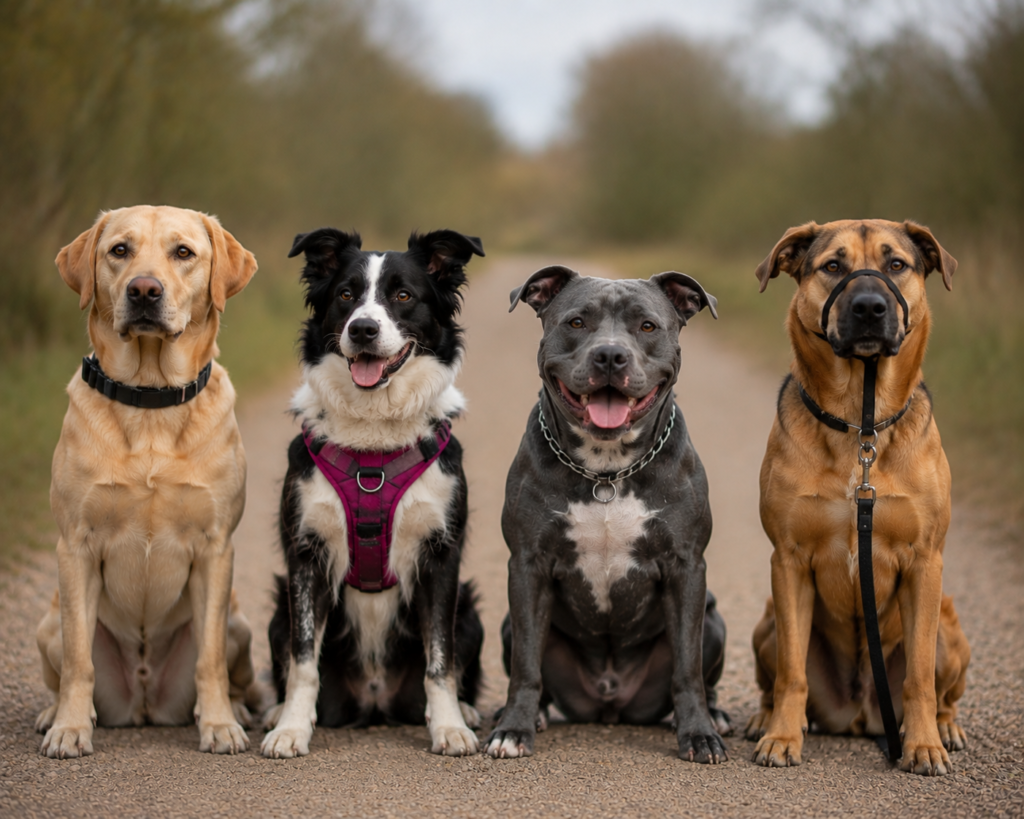
 Equipment Alone Does Not Fix Pulling
Before looking at walking devices, it is important to understand one key point:
No piece of equipment teaches loose lead walking on its own.
Tools can assist training, but they do not replace it. Without teaching the dog how to walk on a loose lead, most dogs will continue to pull regardless of what they are wearing. They will just adapt their pulling technique to the different device used.
Lead walking is a skill that must be taught through repetition, consistency, and clear communication.
 The Lead Itself Matters
Lead walking is also influenced by the type of lead used.
Dogs quickly learn the length of their lead. If they are always walked on a short lead, they learn that this is their boundary. If you switch to a longer lead, they will still tend to move to the end of it and pull regardless.
Retractable leads are definitely my pet hate, mainly due to the safety concerns associated with it. Retractable leads reduce the handler’s ability to react quickly if a dog lunges, runs towards a road, or reacts to another dog. The thin cord can also cause burns or injuries if it wraps around legs or if you try to grasp it with your hand to quickly stop your dog from pulling forward. There is very limited control with these leads, and the dog will never learn the length of their lead as it continuously changes, therefore promoting pulling rather than granting freedom.
Long leads are a different story to retractable leads and there are limited situations where they are appropriate, mainly when walking in large open spaces, when trailing, or in training situations, especially with recall work. However, they should not be used as a default walking tool.
For everyday walks, a fixed-length lead of around 1.5 to 2 metres is generally ideal. It provides a balance between freedom of movement and handler control.
Collars
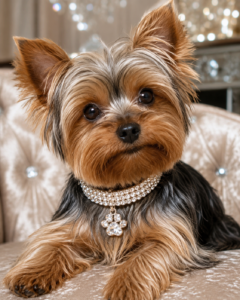
Collars are the most commonly used walking device and come in many forms, including nylon, leather, and padded options. For some dogs, or more accurately the owner, they can be a fashion statement. We all know the little Yorkie sporting their bling bling, or the American Staffy with the heavy studded leather collar.
The most important factor is suitability for the individual dog. A very thin-necked dog may not suit a heavy leather collar, as this adds unnecessary weight and pressure. In contrast, dogs with longer necks, such as greyhounds, are often better suited to wider collars that distribute pressure more evenly.
Fit is critical. A collar that is too loose increases the risk of slipping out, which can lead to serious safety risks, including road accidents or dog-on-dog incidents.
The neck also contains important anatomical structures, including the trachea, oesophagus, cervical vertebrae, muscles, nerves, lymph nodes, and glands. Repeated pulling on a collar can place strain on these structures and can contribute to conditions such as laryngeal paralysis or tracheal collapse.
Pros:
- Simple and easy to fit
- Quick handling and control
- Offer more control when compared to a harness due to the point of attachment
- Tags and the dog’s ID can be attached
- They can be worn permanently
Cons:
- Risk of slipping if poorly fitted
- Neck injuries and strains cab occur with chronic pulling
- Thought unlikely, they pose a certain choking hazard when left on permanently
Harnesses
Harnesses are increasingly popular and, when fitted correctly, can be a very good option for many dogs.
Fit is everything. Different body shapes require different harness designs—deep-chested dogs, long-bodied dogs, and compact breeds all need appropriate fitting.
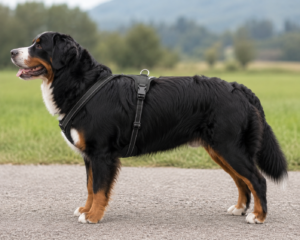
A well-fitted harness should:
- Sit clear of the armpits to avoid rubbing and discomfort
- Allow full shoulder movement
- Have the Y-piece at the chest sitting over the sternum (manubrium); even when the dog is pulling, the Y-piece should stay centred rather than ride up the neck
- Sit snug enough that the dog cannot back out; two fingers should fit under each strap
- It should stay centred on the dog’s body rather than rotate to the side
 Some harnesses sit across the shoulders or include front-clip attachments. This attachment style is great when doing targeted training but are not ideal in the long-term use. Rather than teaching the dog to not pull, dogs tend to lock in their shoulders and move in a tense, forward-driven walking style. Other dogs walking towards you may interpret this as an aggressive approach which may result in a conflict.
Harnesses can also be slipped out of if poorly fitted, especially if you have a long-haired dog and adjust the harness to the fluff rather than the body shape. Deep chested dogs, like sighthounds, may be able to back out of the harness. And some dogs are just Houdini’s!
So, finding the right fit is crucial, and you might need to trial various harnesses to find the right one. If you own a specific breed, asking other owners with the same breed may be a helpful starting point.
Pros:
- It does not place strain on the neck if fitted properly
- Preferred device for brachycephalic dogs, like Pugs and French Bulldogs, as it does not place any extra strain o their neck which may make breathing more difficult
- The dog may be less likely to slip out compared to a collar when fitted correctly
- Handles on the back can be useful for quick lifting or guiding
- The best device for certain dog sports, like trailing or sled work
Cons:
- Fit must be precise to avoid rubbing, choking or discomfort
- Can restrict shoulder movement if poorly designed
- Risk of escape if it is the wrong design or not fitted properly
- Can promote pulling if the dog is not trained well
- If your dog does charge forward, greater physical strength by the handler is needed as the attachment point is at the body centre rather than the head
- Offers the handler less control over the head, which can be tricky in challenging situations, like walking in a crowded environment
 Head Collars (Halti)
Head collars, such as the Halti, fit over the dog’s nose and provide control over the head, which guides the rest of the body.
They are often the most effective tool for controlling strong dogs, particularly for handlers who may not have the physical strength or stability to manage large or powerful breeds.
However, they require careful introduction. Dogs do not naturally accept them and must be gradually conditioned using positive reinforcement. Many dogs initially resist, rub their noses, or try to remove them.
A collar must always be used in conjunction with a Halti, as the device can easily slip off.
Incorrect use can create problems. Holding a dog too short or forcing the head into a fixed position can increase anxiety and discomfort. Sudden jerking or twisting can also place strain on the cervical vertebrae, potentially leading to long-term injury.
Similarly, allowing a dog to build speed and then abruptly stopping them through a head collar can create excessive force through the neck.
When used correctly, however, a Halti can be a very effective control tool, especially in situations where safety is a priority.
Pros:
- High level of control as it directly controls the head
- Particularly useful for strong dogs
- Helpful for handlers with physical limitations
Cons:
- Requires careful introduction and training before using it on walks
- Risk of neck strain and serious spinal injury if misused
- Can never be used with a long lead
- Must always be double-attached to a collar
 Check Chains (Choker Chains)
Check chains are one of the most misunderstood walking tools and definitely get a bad rep as they are used incorrectly on so many occasions!
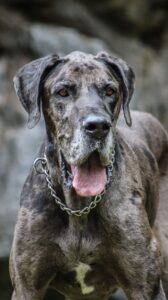
When used correctly, a check chain is not designed to “choke” a dog. Instead, it works as a self-correcting training aid. When the chain tightens, the links of the chain travel through the ring, creating a distinct sound. This sound is intended to cue the dog to reduce tension and return to a loose lead.
For this reason, proper equipment and fit are essential. A well-made metal chain (such as quality training chains) provides clearer feedback than lower-quality alternatives.
A check chain should always sit loosely at rest, with approximately 10 cm of slack when positioned correctly. It needs to be applied with the correct side tightening and releasing and applying it will depend on the side your dog walks on.
Placement is critical. It should never sit high under the throat or directly behind the ears, where sensitive structures such as the larynx and hyoid bone are located. Misuse can lead to significant discomfort or injury, particularly if sudden force is applied. Same as the collar, if there is chronic pulling, it can contribute to laryngeal paralysis and tracheal collapse.
 Nylon slip have the same idea as a check chain, though as all they do is tighten, they will just punish the dog rather than giving the chance to self-correct behaviour, therefore lacking meaningful feedback.
While check chains can produce fast behavioural responses, this does not always equal learning. They require precise timing, correct fit, and structured training to be used safely and effectively.
For this reason, professional guidance is strongly recommended before using this type of equipment.
Pros:
- Clear feedback and chance to self-correct when used correctly
- Gives better control compared to a collar or harness, especially with strong dogs
- Effective in experienced hands
- They are very durable
Cons:
- High risk of neck injury if misused
- Requires skill and timing, which should usually be taught by an experienced dog trainer
- Will not work as intended if fitted incorrectly
- Choking hazard if left on unsupervised, so it always needs to be removed after each walk
- Not suitable for inexperienced handlers
