The Initial Aftercare
Initial aftercare mainly focused on three key areas: pain relief, rest and comfort, and bladder management. Together with early rehabilitation, which will be covered in the next chapter.
Pain relief
Pain relief goes far beyond medication. Your surgeon will prescribe painkillers to keep your dog comfortable, but there are several additional strategies that can significantly improve comfort:
- Cryotherapy (cold therapy): Applied to the surgery site to reduce inflammation and swelling
- Thermotherapy (heat therapy): Applied to the upper back and shoulders to relieve secondary muscle tension and encourage relaxation. Some much-needed rest and a good sound sleep after a possibly lengthy and stressful stay at the vets can work wonders. Red light therapy along the upper back, shoulders and neck can work well to settle down your dog and provide some relaxation
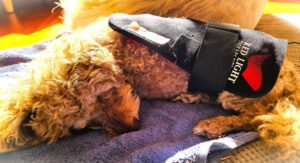
- TENS (Transcutaneous Electrical Nerve Stimulation): Dog-specific TENS units, applied across the disc site, can be useful to alleviate pain when used with the appropriate settings
- Gentle massage: Light thumb strokes along the incision site support circulation and decrease fluid accumulation under the skin
These techniques not only manage pain but also help your dog relax, which is crucial for early healing.
Rest and Comfort
Crate rest or restricted movement is critical after an IVDD event, whether your dog had surgery or is being managed conservatively. Dogs often feel frustrated when confined, so balancing safety with family inclusion is key.
Many owners find it helpful to:
- Use a large crate or playpen with the dog having enough space to be comfortable, especially if they have an Elizabethan collar on
- It needs to be lined with non-slip flooring and ideally have an orthopaedic mattress to provide a comfortable resting area
- Provide access to water and a puppy pad if necessary
- Have multiple crate locations so the dog can participate in family life, or position the play pen in a central area of the house, so that your dog does not feel left out
Restricting movement prevents dogs from pulling themselves along with their front limbs, which can cause tension in the shoulders, pressure sores on the hind limbs, and risk of re-injury, due to slipping, falling, or attempting movements that need to be avoided.
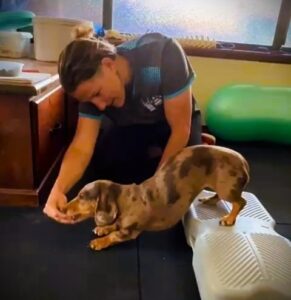
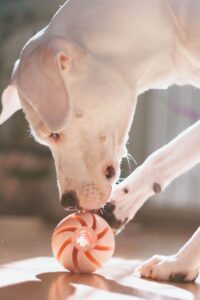 Environmental enrichment—like puzzle feeders or safe toys—can help prevent boredom and frustration during crate rest. Working on trick training can be a helpful mental stimulation for the dog, but ensure you find the right trick, e.g. nose touches to the hand, bark on command or the “cup game”. Anything that allows your dog to stay resting and doesn’t challenge them physically whilst keeping them mentally active.
Proper handling is an important factor of aftercare. When lifting your dog:
- Place one hand under the chest and the other under the pelvis
- Keep their back straight and cradle your dog close to your body to make them feel secure
- Communicate your intentions to nervous dogs before handling
Bladder management
Bladder care is essential in the early days after an IVDD event, and sometimes for a few months, as the return to active urination varies for each dog. Monitoring and supporting your dog’s bladder help prevent complications such as urinary tract infections.
- Manual expression: Typically, every 4–6 hours if no catheter is in place. This is done by locating the bladder and applying light pressure either side. Do your best to fully empty the bladder each time, as urine pooling can be an excellent breeding ground for bacteria. If your dog is hard to express, it may be a good idea to have a cystostomy tube placed instead. If your dog has not urinated for 12 hours and you are unable to manually express their bladder, this is a potentially serious situation, and veterinary attention should be sought immediately.
- Cystostomy or urinary catheter care: These can make the emptying of the bladder a lot easier, though urinary catheters should not stay in place for longer than two weeks, due to the increased risk of bladder infections. It is important to keep the insertion sites clean by wiping them twice daily with diluted Chlorhexidine and monitoring for signs of irritation, like redness and swelling, or the dog showing discomfort.
- “Sniff test”: Maybe not the nicest, but sniffing the urine can give you an indication of any underlying problems, like UTI’s. If this is the case, it is always best to address them early.
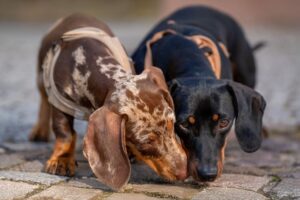
- Active urination: The ultimate goal when it comes to urination. Your dog will show active participation in urination, like crouching or releasing a stream of urine. Encourage voluntary urination by first ensuring that they have a fullish bladder, carry them outside to their favourite pee spot or a spot where another dog recently urinated. Make sure they are supported with a harness, but that their penis or vulva are not obstructed. Apply light pressure around the bladder to point out the “urgency” to urinate and give them time with limited distractions. Don’t get disheartened if this method doesn’t work the first time, perseverance is key!
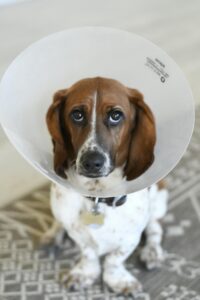
Dogs with urinary catheters or cystostomy tubes must be supervised carefully, as they might be tempted to chew the insertion site, especially if there is some inflammation or irritation. Chewing or accidental removal can lead to serious complications and often makes another surgery inevitable.
So yes, unfortunately the Elizabethan collar will need to stay on, and it needs to be long enough to ensure those long schnozzes don’t reach the bits they are not supposed to.
Stages of Rehabilitation
Rehabilitation is a gradual, structured process tailored to your dog’s abilities and healing stage. No two dogs recover the same way, so the rehabilitation plan always needs to be adjusted according to the individual’s presentation and progress.
Early Stage of Rehabilitation
Early rehabilitation ties in with the initial aftercare and emphasises the management of pain, inflammation and swelling, joint motion and early limb use.
Rehabilitation ideally begins within a few days of injury or surgery, taking the healing process and the dog’s abilities into consideration.
Key elements include:
- Cryotherapy: Ice packs over or around the surgery site can greatly help with decreasing swelling and inflammation around the surgery site. Care needs to be taken that your dog is comfortable with the treatment and that there is no contamination of the surgery site.
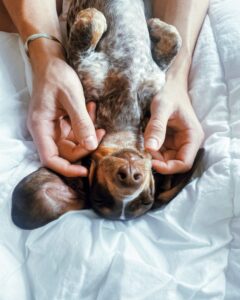 Thermotherapy and Massage: Heat therapy or Red Light Therapy is an ideal medium to relax tight upper back muscles. This will promote relaxation for your dog and can be followed by a gentle massage. When done right, this can be a great bonding experience between you and your dog, and I am sure they will love you for the extra attention.
- Therapeutic Laser: When applied to the surgery site (using a Class 4 Laser), this can help with pain, swelling and wound healing. For both conservatively and surgically treated dog, it may help in the recovery of injured nerves.
- Assisted Standing: Abdominal support and the avoidance of slipping and twisting is important with this early exercise. Care needs to be taken to re-educate proper positioning of limbs, so promoting proprioceptive awareness is an important step in this phase. Proprioception refers to “awareness in space”, the body’s automatic ability to sense its own position, movement, and force in space.
- PROM (Passive Range of Motion): Maintains joint mobility and decreases spasticity
- NMES (Neuromuscular Electrical Stimulation): Stimulates contraction of musculature, mainly used if the muscles lack tone due to decreased neurological input
- Assisted Walking: This will encourage early limb use and motor function but also allow for some environmental enrichment and the chance to encourage active urination. Walks need to be attempted multiple times a day, though kept short, ensuring your dog is properly supported with a sling or harness support and a lead attached to a collar or chest harness to limit the dog’s speed to a walking pace. Once more, avoid slippery surfaces like tiles or floorboards.Sling support should ideally be positioned beneath the pelvis to provide effective support to the hindquarters. A simple homemade sling can be made by crossing two leads or scarves under the hips, or by using a reusable shopping bag with two holes cut for the hind legs, creating a comfortable cradle to assist with mobility.
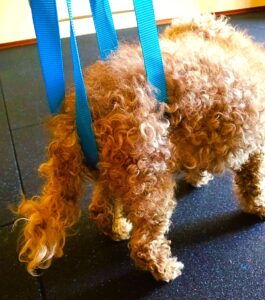
- Assisted Sitting: Instead of your dog plonking themselves into a sitting position with both hindlegs pointing straight forward or to the side, re-educate proper alignment and proprioceptive awareness by guiding your dog into a properly aligned sitting position with the hindlegs evenly positioned underneath the body.
This basic approach to rehabilitation allows for the core goals to be achieved, which include prevention of muscle atrophy on the hind limbs and core muscles, stimulation of nerves to encourage the return of motor reflexes and the reduction of spasm in the hind limbs.
Once the acute and subacute phases following injury have passed, significant healing around the disc site should have occurred, and your dog will usually be feeling much more comfortable. You may notice them attempting—or even managing—a full-body shake again, which is often a good sign that they are feeling more like themselves. At this point, rehabilitation can gradually be progressed to the next level.
Middle Stage of Rehabilitation
This stage emphasizes gait training, proprioception, and early strengthening, spanning from early limb use to using limbs well at a walk with minimal proprioceptive deficits.
Crate or playpen rest continues, and most dogs are gradually weaned off NSAIDs, though medications like Gabapentin may continue.
All other therapies, including bladder management and nursing care, cryotherapy over the surgery sits, thermotherapy and massage for relieve of upper back muscle tension, NMES for muscle engagement and strengthening and Laser therapy for healing and spinal cord recovery will continue if needed.
Progression of exercises may include:
- PROM: May progress to bicycle movements, incorporated into the standing exercise
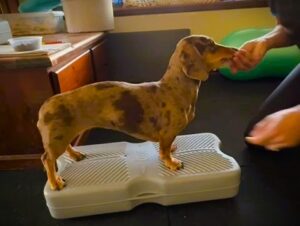
- Assisted Standing: Abdominal support will slowly be decreased and weight shifting and gentle turning exercises may be incorporated. This exercise is still crucial until your dog can generate a reasonable gait pattern. With improving strength in the hind limbs, the challenge of this exercise will be increased by the introduction of balance boards, inflatable discs and foam pads or cushions. The aim is to challenge the dog’s proprioceptive awareness and encourage balancing, which engages all the small stabilising muscles, alongside with a greater challenge for core and back muscles. Consider the increased challenge for yourself when doing a normal plank and then performing the plank with your arms resting on a Bosu ball.
- Assisted Sitting: If your dog is still struggling to fold into a functional sitting position, continue this exercise. With time, active, controlled rising can be encouraged.
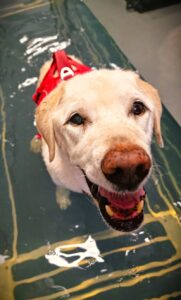 Assisted Walking: At this stage, your rehabilitation specialist may introduce walking on a Land or Underwater Treadmill. They will provide gait assistance, to encourage a proper gait pattern to stimulate the dog’s muscular and nervous system, encouraging functional movement. Once the dog has regained some motor control of the hind limbs, walking may be altered to include wide Circles, Figure 8 or Weaving patterns.
Late Stage of Rehabilitation
In the late stage, your dog should demonstrate independent walking and more functional use of the hind limbs, including unassisted standing and normalised reflexes. Focus is on building strength, endurance, and speed and improving proprioception and limb coordination.
Massage and/or Red Light Therapy of the upper back may still be beneficial if your dog continues to experience muscle tightness or tension in this area.
NMES stimulation should be completely replaced by active exercise now.
Bladder function should be back to normal by this stage, although it remains important to monitor for any urinary complications, such as urinary tract infections (UTIs).
Cryotherapy and Laser Therapy over the disc site should no longer be required.
Progression of exercises may include:
- AROM (Active Range of Motion): If you dog no longer exhibits spasticity or restrictions in the hind limbs, you can progress from PROM to AROM. A perfect exercise for this is Cavaletti rails.
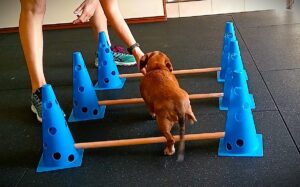
- Assisted Standing: This exercise will become more challenging by adding unstable surfaces, as well as adding dynamic components to the static exercises.
- Assisted Walking: Walks should be back to normal leash walking, gradually increasing the duration of walks before introducing additional challenges, such as walking on inclines and declines or navigating more varied terrain. Short jogging intervals may be incorporated as your dog’s strength and coordination improve; however, proper timing, control, and supervision are essential. Keep in mind that increasing speed also increases ground reaction forces, placing greater stress on the joints, including the joints between the vertebrae. Circles, Figure 8 or Weaving exercises may become tighter and may incorporate obstacles for your dog to step over.
- Sit-to-Stand: This will be the progression of the assisted sitting exercise and is now aiming at muscle building, targeting hind leg extensor muscles, mainly gluteus medius (part of the butt muscles), vastus lateralis (one of the quadriceps muscles) and the cranial part of the biceps femoris (part of the hamstring group).
Towards the end of the late stage of rehabilitation, your dog should approach normal everyday function, meaning, at the minimum, they will be able to go for a controlled leash walk again, have bladder control and live an independent lifestyle. Some dogs will take a few weeks, others several months to reach this stage.
Contributing factors to recovery time may include:
- Injury severity and treatment approach
- Dog’s age, fitness, and weight
- Surgical success or flare-ups
- Consistency of rehabilitation
- Complications like recurring UTIs
Ultimate Rehabilitation
After a successful recovery, recommendations are to avoid the dog jumping, rough play with the siblings or slipping and sliding around corners in the house.
But I think everyone knows a naughty sausage dog, ignoring the well-meant ramp beside the lounge, having to race to the door to guard the house from the posty, or spurring on their sibling to a play session.
Furthermore, some owners had a very active lifestyle with their dogs prior to the injury, going for hikes, letting them romp around at the beach, maybe even swimming with the dog or taking them SUP!
This is where the ultimate rehabilitation comes in.
The goal of ultimate rehabilitation is balanced, functional movement, targeting any remaining small deficits. Minor deficits, like decreased range of motion or uneven loading, are addressed to prevent possible future injuries caused by compensation.
To achieve this level of recovery, targeted exercises should be performed at home several times per week. Daily exercise, appropriate weight management, a balanced diet, and, where indicated, nutritional supplements all play an important role in maintaining strength, function, and spinal health.
Follow-up appointments with your rehabilitation specialist are typically only required every 1–2 months to review progress, adjust the exercise program as needed, and address any emerging concerns.
The High Five Paws Rehabilitation Approach
At High Five Paws, my approach is strongly exercise-based, with the goal of promoting balanced, functional movement. The additional benefit is that you, as the owner, get to closely work together with your dog. This can strongly improve the bond between the two of you, and a lot of dogs really appreciate this extra time spend with their main person.
During the Initial Assessment, we thoroughly review your dog’s lifestyle, medical history, reflexes, and functional abilities. By considering their current stage of healing, we can create a personalised home care and rehabilitation program tailored to their specific needs and goals.
This will be combined with therapies or treatments on the day, depending how your dog is presenting, and may include assisted treadmill walking, NMES, TENS, massage, Red Light Therapy, PROM and exercises.
Short-Term Goals
- Pain relief around the disc site
- Muscle preservation in effected limbs
- Maintenance of joint range of motion in the effected limbs
- Core engagement for muscle preservation and back support
- Bladder support advice
- Management of urinary catheters and cystostomy tubes
- Home care advice, including handling, creating a safe environment and environmental enrichment
- Calculating RER (Resting Energy Requirement), to avoid your dog putting on weight during their recovery
- Advice on safe sling or harness walking
- Balance retraining by slowly challenging proprioceptive awareness
- Relief of muscle tension in the upper back, shoulders and neck
Long-Term Goals and Maintenance
- Reduce risk of recurrence by decreasing risk factors
- Restore independence and quality of life
- Building strong core muscles
- Balanced hind limb strength and muscle symmetry
- Spinal stability by building strong back muscles
- Increasing confidence by slowly challenging your dog’s abilities
- Improved strength and endurance by building on exercises
- Working on any areas they may be lacking to restore safe functional movement
These goals underline High Five Paws’ philosophy:
Restoring Balance, Renewing Vitality