
Treating IVDD in Dachshunds: Surgery vs. Conservative Care and What Recovery Really Looks Like

Close-up of a brown dog's face resting on vibrant green grass

Recovery after IVDD is rarely straightforward.

Having worked with Dachshunds for over six years as a specialist surgical nurse, and over seven years in rehabilitation, I want owners to know one important thing:

Recovery is a journey, not a quick fix.

Some dogs improve quickly.

Others need months of dedicated support.

This is where rehabilitation becomes essential.

Surgery vs Conservative Management

Deciding between surgery and conservative management is often the hardest choice for owners. Both have pros and cons, and while certain cases lean toward one approach, no treatment guarantees full recovery.

SURGICAL MANAGEMENT

When is it recommended?

In Australia, higher-grade IVDD cases are still most commonly managed surgically:

  • Grade 3: Sometimes recover with conservative care, but surgery is considered if no improvement occurs within 48 hours or if the dog worsens
  • Grade 4: Surgery is usually recommended
  • Grade 5: Conservative treatment usually has poor outcomes
Common Surgical Procedures
  • Hemilaminectomy: A common surgical approach.

Long word, but easy to explain. There are three parts to the word:

    • Hemi-: one side
    • Lamina: part of each vertebra, forming the “arch” or roof over the spinal cord
    • -ectomy: surgical removal

This procedure removes part of the vertebral bone to relieve compression on the spinal cord, restoring blood flow and minimizing permanent spinal cord damage.

  • Disc fenestration: Often done alongside decompression surgery to reduce the risk of future disc herniations. It involves making a small hole in the outer disc layer and removing the inner material, typically in other calcified discs, to prevent recurrence at different sites.
Risks for Grade 5 IVDD

Timing is thought to be critical and surgery is ideally done within 12-24 hours, though there is not much scientific evidence that recovery chances decrease after this time frame.

However, it’s important to consider that delaying spinal decompression beyond 12 hours in Grade 5 IVDD cases may be associated with a higher risk of developing myelomalacia—a rare but fatal softening of the spinal cord. This supports the recommendation to perform decompression as soon as possible, ideally within 12–24 hours of injury.

Recovery chances by Grade
  • Grades 1–2: >95% (conservative care often works well)
  • Grades 3–4: ~93% achieve independent walking
  • Grade 5: ~50%

Note: “Successful neurological recovery” means your dog can walk independently and toilet on its own, not necessarily returning to pre-injury activity like running on the beach or jumping on furniture.

Consult your surgeon: This introduction on surgery is supposed to give you a generalised, but limited, overview only. Your surgeon is always the expert when it comes to surgery and will be able to talk you through their diagnosis and best way to proceed.

CONSERVATIVE MANAGEMENT

Conservative management of IVDD has become an increasingly discussed option among owners and veterinarians. However, there is still limited scientific data on its effectiveness, and the studies that do exist are often retrospective or involve only a small number of dogs, making it difficult to draw firm conclusions. Despite this, many owners are interested in exploring conservative care, especially for lower-grade cases or when surgery is not immediately feasible.

Conservative care relies on the body naturally reabsorbing disc material and allowing space around the spinal cord to return to normal. Strict crate rest helps the torn disc heal with scar tissue and prevents further rupture.

What Grades usually do well
  • Grade 1-2
  • some Grade 3 cases
  • flare-ups or recurrence episodes (unless Grade 4-5 at a new site)
Recovery chances by Grade

As mentioned before, a lot more research needs to be done to gain a better understanding of recovery success.

Grades 1 and 2 usually have great recovery chances and are generally considered good candidates for conservative management.

A paper from 2017, analysing the results from 20 studies, and therefore including a substantial number of dogs of IVDD Grades 3 to 5, showed the following results of successful neurological recovery after an IVDD event:

  • Grade 3: 79% recovery
  • Grade 4: 62% recovery
  • Grade 5: 10% recovery

A more recent study suggested that conservative management of IVDD in Grades 3–5 may have higher success rates than previously thought, though it’s important to note that the study included only 72 dogs, so the results are based on a relatively small sample. In this study, successful recovery was defined as the dog being able to take 10 consecutive steps on its own—a practical measure of functional mobility.

  • Grade 3 and 4: 96% of dogs achieved successful recovery
  • Grade 5: 48% of dogs achieved successful recovery

All dogs in the study began physiotherapy and short, controlled walks from day 2 after injury, repeated 4–5 times per day. This highlights the critical role of early, structured rehabilitation, even when opting for conservative care, and suggests that with careful monitoring and consistent exercise, many dogs can regain meaningful mobility without surgery.

What it involves

Conservative management is more than rest and pain relief. It’s a multimodal approach:

  • Pain management and anti-inflammatory medications
  • Possible tranquilisers to keep the dog calm
  • Careful bladder monitoring
  • Structured rehabilitation starting a few days after injury
  • Nursing care to ensure comfort

In saying that, the recovery journey after surgery is actually going to be very similar to managing it conservatively, so we’ll take a closer look at recovery in the next chapter.

What Recovery Really Looks Like

Some dogs walk and urinate independently within days after surgery. Others may not show meaningful movement for months—or perhaps ever.

Whether choosing conservative or surgical treatment, both approaches can succeed, but recovery is time-consuming and demanding, requiring a lot of dedication and resilience.

When Recovery Is Incomplete

This is admittedly a difficult and sometimes bleak topic, but it deserves a place in this blog because it is rarely discussed—and often not considered—when you’re first faced with an IVDD diagnosis. Your GP vet or surgical specialist will likely talk to you about recovery chances, and you may hear stories from other owners, such as a dog that “walked again after four weeks,” or one that “started moving their hind legs within a few days,” or even “regained full bladder control by the time they left the hospital.”

Some dogs truly do recover beautifully, and these stories give hope. But having worked in this field for years, I’ve also seen the other side: dedicated owners caring for a dog that never fully recovers, dealing with ongoing complications and secondary issues that arise from the initial spinal injury.

Because of this, I believe it’s only fair to paint the full picture, including what can happen if your dog doesn’t make a full recovery. Understanding the potential long-term challenges allows owners to prepare, plan, and make informed decisions, rather than being caught off guard when unexpected complications arise.

Urinary issues: I know a few people where their dog never recovered movement in their hind legs, and some of them never recovered urinary or faecal control. This means that you will have a continuous job of cleaning up pee, not only on your floors and the dog’s bedding, but also continuously cleaning the dog. If you don’t do a thorough job, the dog may start suffering from urinary scalding, which is a painful skin condition caused by prolonged contact with urine. Furthermore, if your dog does not have bladder control, you will have to express multiple times a day, which is no issue when you are home, but may be a concern when you have to go to work.

Inability to properly control their bladder function will cause some secondary issues. Recurrent UTI’s are common, with infections mainly being caused by residual urine pooling from incomplete emptying of the bladder. This can lead to long term issues. Chronic bladder inflammation can cause scarring of the bladder. Bacteria can travel up the urethra to the kidneys and cause an infection which could lead to chronic kidney disease. Repeated antibiotic courses can lead to multi-resistant bacteria, making the treatment so much harder and often requiring long-term use of antibiotics to control the infection.

Hind-leg paralysis: Inability to use the hind legs will come with its own issues. Your dog may develop sores on their hind feet if they are dragging over rough surfaces. These can be hard to treat as they just may never get a chance to heal properly before being irritated again.

Dogs are also going to redistribute loading, meaning overusing their front limbs to get around. Constant “front-loading” leads to chronic muscle strains and early onset or acceleration of osteoarthritis in front joints.

The continuous twist along the back will cause multiple trigger points and back pain. Lots of massages, heat treatment for the upper back, pain relief, stretching and range of motion exercises in their front limbs will take up a portion of your time to keep your dog feeling well and happy.

If your dog does recover some function in their hind legs and are able to get around, you will have to consider altering your home environment. Your shiny floorboards may be covered with yoga mats from now on. You are going to be the lift for your dog to get up and down the stairs. Multiple crates may be needed around the house to give the dog a safe area to relax with the family.

 Behavioural changes: Apart from the body not functioning the way it used to, many dogs may develop behavioural issues, with separation anxiety and hyper-attachment being one of the most common.

They may be frustrated once they lose the ability to move independently, or when you are leaving the room, leading to increased vocalisation.
Charming portrait of a wire-haired dachshund with a curious expression and distinctive fluffy ears.

When out on walks, they may become more reactive towards other dogs as they have a heightened sense of vulnerability.

They may also become depressed and start hiding or lose enthusiasm for things they enjoyed prior to being injured.

Long-term considerations: Most of the time, you will be able to deal with all these changes. And if it is short term, owners usually don’t have an issue with it.

But what if it is long term?!

What if your dog is paralysed for years?

Who is going to care for your dog when you are at work?

Who is going to look after them and all their special needs if you ever want to go on a holiday?

What happens if your family grows and you are having your first baby?

As I said, this is not a happy subject, and by no means do I want to discourage you from ever pursuing surgery or conservative management when faced with an IVDD injury. As mentioned before, chances are good that you will get a functional dog back.

But I also want to show you the reality of when it does not work. And having worked with a few Dachshund owners over the last years I most certainly have seen both sides.

Functional Recovery and Why Early Rehabilitation Matters

I have worked with dogs who did not begin walking again until many months into rehabilitation, and yes, you have guessed right, most of them were Grade 5 or “high” Grade 4 dogs.

This is why I always encourage owners:

DO NOT LOSE HOPE TOO EARLY.

Progress with neurological recovery can be slow and it is believed that they are able to show progress till around 9-12 months after the injury. Afterwards, there usually is not much change.

There will be days when your dog is doing really well, and other days when it just seems hopeless.

Guiding your dog through the recovery from IVDD takes a lot of patience, resilience, and occasionally a bottle of wine. Or three!!!

Alongside the initial care needed to keep your dog well, structured rehabilitation plays a major role in successful recovery.

Early guided rehabilitation is key to improve outcomes:

  • Assisted standing and sit-to-stand exercises
  • Gentle weight shifting
  • Passive range-of-motion exercises
  • Supported walking
  • Core engagement and balance exercises
  • Massage to reduce tension and improve comfort
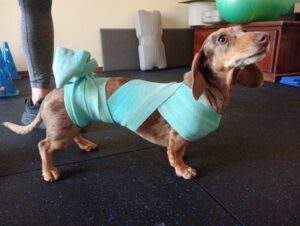
Muscle loss begins within a week, so early structured care is vital. Rehabilitation sessions are best done in short intervals, multiple times per day, combined with regular bladder care.

The initial aftercare and rehabilitation can be a full-time job and very daunting, but usually with time, you will get the hang of it, and what seemed so overwhelming at the start might become routine.

There are various services out there to help with this initial aftercare. High Five Paws offers services like “Disabled Doggy Daycare” for early-stage recovery.

Many fellow Long Dog owners have faced IVDD with their own pets and may be able to offer occasional help during the day, whether that’s letting your dog stretch their legs, assisting with bladder care, or simply providing companionship. One thing I’ve learned over the years is that Sausage dog owners form an incredibly supportive community. There’s a remarkable amount of love and dedication for these little dogs, and help is often just a message or phone call away—people truly want to support one another during challenging times.

Stay tuned for Part 3, where we’ll explore initial aftercare after an IVDD injury, early and progressing rehabilitation, long-term flare-up prevention, and how High Five Paws supports IVDD recovery and how we can help your dog with restoring balance and renewing vitality.

High Five Paws logo paw

Need help with an IVDD recovery plan?
At High Five Paws, I provide personalised rehabilitation support for both surgically and conservatively managed IVDD cases.