
The cranial cruciate ligament (CrCL) in dogs is similar to the ACL in humans. It stabilises the knee (stifle joint) and prevents excessive forward movement and rotation of the tibia.
When this ligament is torn or ruptured, dogs may show:
- Lameness or limping in the affected limb leg
- Difficulty rising or jumping
- Sitting unevenly (often with the affected leg out to the side)
- Muscle loss in the affected limb (often noticeable within a couple of weeks and can persist long-term)
CrCL rupture can occur as an acute, trauma-induced injury, but more commonly develops gradually due to ligament degeneration. Dogs may present with sudden lameness or a more subtle, progressive limp as partial tearing worsens over time. Regardless of how it occurs, osteoarthritis will begin to develop and can significantly impact long-term limb function.
To give your dog the best chance of recovery, surgery is often recommended, ideally sooner rather than later.
There are two main categories of surgical repair:
- Extracapsular repair: A strong nylon suture is placed outside the joint to mimic ligament function and stabilise the stifle. Over time, scar tissue forms to support the joint. This is more commonly recommended for smaller dogs or when finances are a limiting factor.
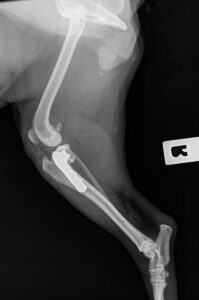 Tibial osteotomy (bone-cutting procedures): These are generally preferred for larger or more active dogs. The most common technique, TPLO (Tibial Plateau Levelling Osteotomy), changes the biomechanics of the knee to eliminate instability rather than replacing the ligament.
There are many factors to consider, so discussing options with your veterinarian is essential.
But surgery is only part of the solution.
After surgery, many owners are advised to crate rest their dog for several weeks. While rest is important, especially in the first 4–5 weeks, rehabilitation should begin early and progress in a structured way.
Key Focus Areas of Rehabilitation:
- Pain Management: Pain inhibits movement and muscle activation. Appropriate pain relief, along with techniques like cryotherapy (icing) is essential in the early phase.
- Restoring Range of Motion: Loss of stifle extension is common after surgery and can lead to a shortened stride. Gentle, controlled exercises help prevent stiffness and restore normal movement.
- Muscle Rebuilding: Muscle atrophy occurs quickly after injury. The most affected muscles include:
- Quadriceps
- Hamstrings (biceps femoris, semimembranosus)
Without rehab, these muscles can reduce to around 60% of their normal size. Targeted exercises are essential to rebuild strength progressively.
- Proprioception and Balance: Injury disrupts your dog’s body awareness. Rehabilitation retrains coordination, stability, and correct limb placement.
- Gradual Return to Function: Recovery is not one-size-fits-all. Progression depends on factors like age, weight, fitness level, surgical technique, and overall health. A tailored program is key—especially for active or sporting dogs.
Successful cruciate recovery isn’t just about the surgery—it’s about the combined effort of:
- Your veterinarian
- Your rehabilitation practitioner
- And you, the owner
Consistency, patience, and guidance are key.
Whilst surgery and subsequent rehabilitation is seen as the gold standard, this may not be the best option for every dog.
Here are some reasons why the owner may choose a conservative approach:
- Small breeds: Small dogs may recover well with conservative management due to less weight on their joints.
- Lifestyle: “Lazy” and less athletic dogs who do not feel the need to run or jump can function well with conservative management, as they may develop scar tissue that stabilises the stifle over time.
 Old dogs: Similar to the less active dogs, the stifle joint may stabilise over time. Owners may also be reluctant to have their dog undergo a long anaesthetic.
- Underlying Health Conditions: Underlying health conditions like heart disease or severe kidney disease will increase anaesthetic risk and may be a reason to consider conservative management. Another one may be endocrine conditions like Cushing’s Disease and Hypothyroidism, as these conditions can greatly impact the healing process.
- Financial Considerations: Surgery can be very expensive, often costing thousands of dollars. Conservative management can be much cheaper, as it focuses on medication, physiotherapy, and lifestyle changes rather than a surgery which requires a specialist.
However, if you have decided on going the conservative approach, keep in mind that this is not a “do nothing” option. It requires a dedicated, long-term commitment (usually 3-6 months), including weight management, activity restriction, working with a rehabilitation specialist on a structured return to function, adequate pain relief and environmental adjustments. Your home may be less than pretty for a while with non-slip mats all over the place.
It is important to acknowledge that conservative management does not mend the torn ligament, it merely relies on scar tissue and muscles to stabilise the joint over time.
Progressive arthritis is still very likely to develop (with or without surgery), but it will progress faster with the conservative approach.
Furthermore, there is a high chance that the cruciate ligament of the opposite leg will tear over time, due to overuse of the sound limb.
Whether you are choosing the surgery route or conservative management, cruciate repair is not a quick fix, it is a journey!
Seeking professional guidance can make a significant difference in your dog’s outcome, so it is always worthwhile to book an appointment with your trusted vet or to seek advice from a certified rehabilitation specialist.
The ultimate goal after all is for a strong and functional recovery, supporting a happy and active life after injury.
At High Five Paws, we’re here to guide you and your dog through every step of the journey—restoring balance, renewing vitality.
